Less measuring. Less dosing. More confidence.
Hydroponics means plants grow in nutrient solution instead of soil — faster and more controllable than in a bed, but the water needs constant care. That's what Verdara automates: pH, nutrients and water level of your reservoir stay within target on their own, while temperature is monitored continuously. Complete kit or DIY bundle, running locally on a Raspberry Pi — no account, no subscription, no mandatory cloud.
Running on my own reservoir for a while now — a first full grow with a plant is still to come.
No marketing. Only launch, availability and important product updates.
Measuring by hand costs time — sometimes the harvest.
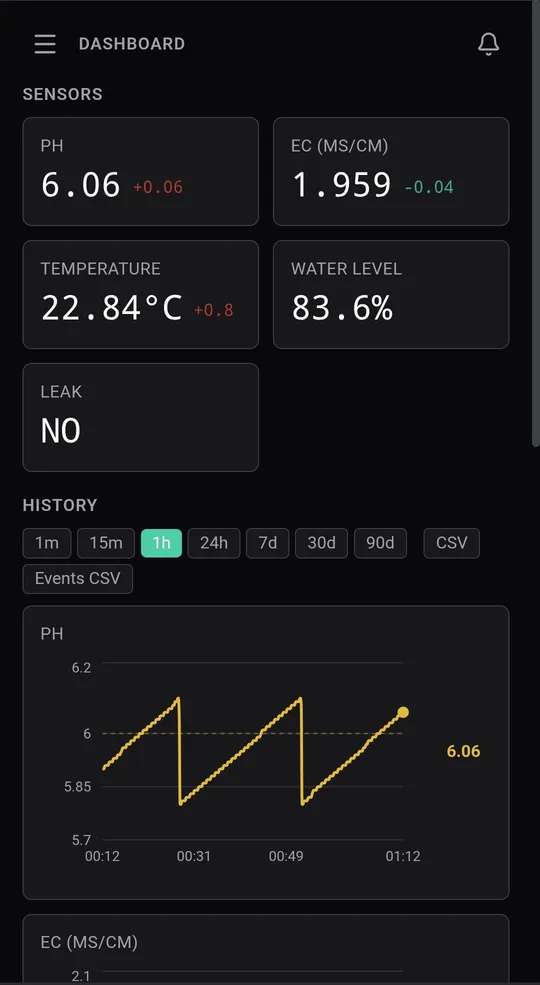
Hydroponics delivers great yields when the reservoir is right. But pH, EC and water level shift over the course of a day — on hot days even within hours. Anyone who wants to keep that under control without automation has to measure manually: often, regularly, and ideally never too late.
pH drifts
After every nutrient uptake, pH rises. Without correction, iron, zinc and manganese precipitate out — deficiency symptoms follow.
EC fluctuates
Plants take up nutrients and water at different rates. Without re-balancing the reservoir gets either too dilute or too concentrated.
Water level drops
On hot days the level falls fast. Pumps running dry or roots exposed to air can decide an entire grow within hours.
Verdara measures, doses and protects — locally.
Six building blocks that run together reliably: measure, dose, safeguard, observe — without cloud, account or subscription.
Sensor monitoring every second
pH, EC, temperature and water level are sampled continuously — with professional-grade Atlas Scientific probes and a waterproof temperature sensor. Dropouts and spikes are detected and filtered in software before they cause bad decisions.
Automatic dosing with a safety net
Nutrients are dosed sequentially, pH-Down separately. After each shot the system verifies whether the correction took effect — if it didn't, it switches to safety mode instead of dosing blindly.
Plant presets & growth phases
Cannabis, tomato, strawberry, lettuce, basil — apply pH and EC targets per growth phase with a single click. A “Next phase” shortcut warns when the jump is too large.
Safety mode & leak detection
A water sensor in the catch tray. On contact, the system shuts everything off — only the emergency drain pump stays active. Safety mode survives crashes and reboots: nothing restarts by accident.
Live dashboard in your browser
Dashboard with live charts, event log and a calibration wizard. Auto-refreshes every second. Dark and light mode. Fully local — reachable on your home Wi-Fi, never via someone else's servers.
Safe software updates
The update check is opt-in — you decide when to upgrade. Each update is cryptographically signed and verified before installation. If something goes wrong, the system rolls back to the last working version automatically.
Atlas Scientific EZO — built in.
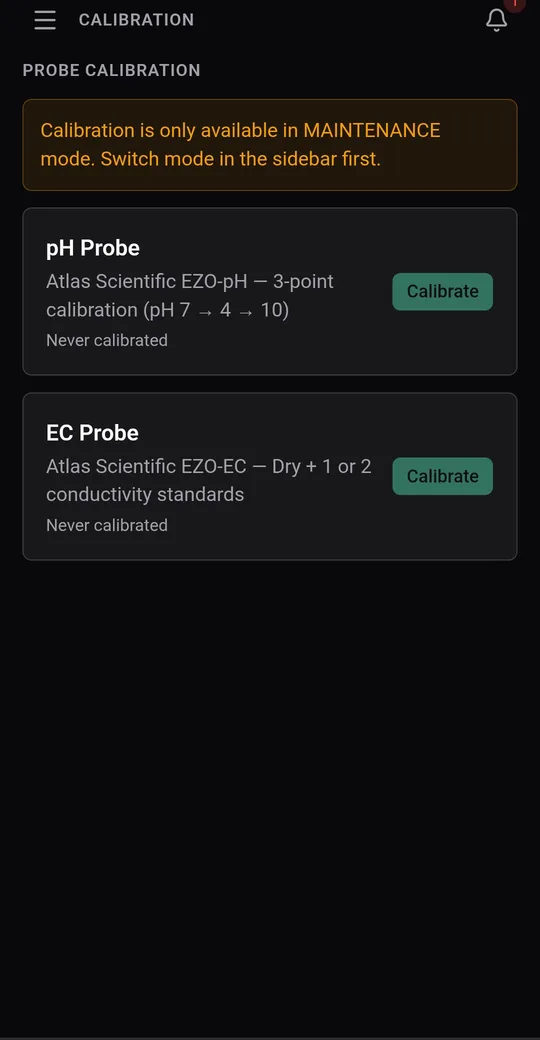
pH and EC are read with professional Atlas Scientific probes — EZO-pH with 3-point calibration (pH 7 → 4 → 10), EZO-EC with dry plus standard calibration. The wizard runs right in the dashboard, step by step — no terminal, no drivers.
Three steps from box to running reservoir.
Connect it
Complete kit: hook up your reservoir, switch on — done. DIY kit: assemble per the build guide and set up your Pi.
Pick the plant
Select the matching preset in the dashboard — cannabis vegetative, tomato flowering, lettuce seedling. pH and EC targets are applied with one click.
Verdara takes over
Sensors are checked every second. Low EC triggers nutrient dosing, rising pH gets corrected. On a leak the system shuts down automatically. You only check the dashboard when you feel like it.
What happens when something goes wrong.
Automatic dosing must not be naïve. Verdara follows a conservative control philosophy: when in doubt, stop and ask — never blindly keep dosing.
Sensor readings are validated
Every measurement is sanity-checked. Spikes, dropouts and implausible jumps are filtered out by software before they can drive a wrong dose.
Dosing runs sequentially
pH-Down and nutrients are never dosed at the same time. A/B components are dispensed individually and stirred in — preventing precipitation and locally over-concentrated zones.
Mixing wait after every dose
After every correction a defined mixing phase runs before the next measurement or dose. The system never builds a correction on top of a not-yet-mixed solution.
SAFE mode with leak stop
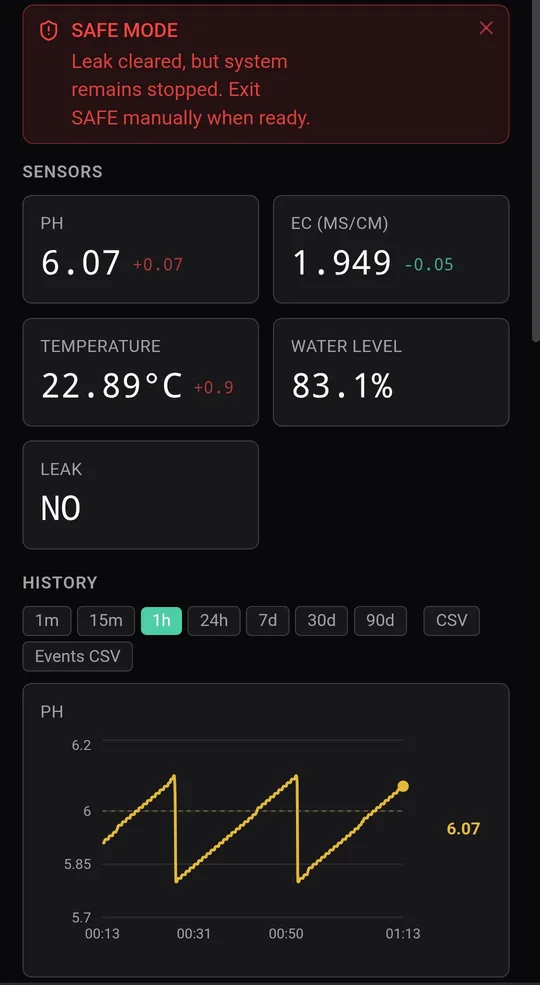
A water sensor in the catch tray triggers SAFE mode immediately — all pumps off, emergency drain on. State persists across reboots; dosing only resumes after manual confirmation.
Local control, internet-independent
Control runs entirely on your Pi. If your internet drops, Verdara keeps dosing. Cloud outages can't take the system down — there are none.
Who Verdara is built for — and who it isn't.
Verdara is a tool for serious home growers. So you know straight away whether it fits:
Good fit for
- Hydroponic home growers running DWC, RDWC or comparable reservoir setups.
- Users who don't want to measure pH, EC and water level by hand every day.
- Technically inclined people who aren't put off by a local Linux system on a Pi.
- Privacy-conscious users who don't want their grow data living in someone else's cloud.
- Continuous-grow setups where stability and safety are meant to pay off across a whole season.
Not ideal for
- One-off mini experiments or single test rigs.
- Pure soil grows — pH/EC control only matters in nutrient-solution systems.
- Anyone hunting for the cheapest kit on the market — Verdara is a deliberate hardware investment.
- Users who refuse any kind of technical setup — even the complete kit needs one clean calibration pass.
Honestly costed. Local instead of a cloud subscription.
Verdara is built for users who grow hydroponically year-round and want a reliable system. You pay for hardware, build and support. No cloud fee, no subscription — and nobody profiting from your data.
Product packaging (DIY kit, complete kit or the controller on its own), hardware and pricing aren't final yet — the overview below reflects current thinking and may change. Anyone on the waitlist gets the final options, pricing and availability before everyone else.
DIY kit
For technically inclined users who want to build it themselves and aren't put off by a Linux system on a Pi.
Weekend project: source the components, wire it up, calibrate.
- Raspberry Pi with licensed Verdara software on SD card
- Recommendation list with concrete components and sources
- Bring-up guide & step-by-step documentation
- Free software updates via signed OTA
- E-mail support during the build
Complete kit
For users who want to start faster — pre-assembled, calibrated, ready to run.
Connect the reservoir, pick a plant preset, switch on.
- Pre-assembled and wired in an IP54 enclosure
- Freshly calibrated probes — no trial-and-error phase
- One contact for hardware and software — no chasing five different vendors
- Phone support during build, ongoing e-mail support
- Hardware terms (warranty / liability) finalised before market launch
Why Verdara isn't a 99-euro gadget.
High-quality sensors, industrial pumps and robust wiring cost money — and they are the prerequisite for automation that you can actually trust. What's in the package:
Atlas Scientific probes with reproducible accuracy — calibratable, long-term stable, replaceable.
Kamoer peristaltic pumps with a defined flow rate. The prerequisite for “1.2 ml” actually meaning 1.2 ml.
Raspberry Pi with the proprietary Verdara controller. Software updates remain free, signed, with rollback.
Sensor validation, mixing wait, A/B sequencing, SAFE mode, leak detection — more than just “sensor X → pump Y” switching.
Mean Well power supplies, WAGO terminals, IP54 enclosure — built for continuous operation across multiple seasons.
E-mail support, phone help on the complete kit, one contact for hardware questions — and continuous software maintenance.
Established manufacturers with long-term spare-part availability.
Comparable automated hydroponics systems run between €1,500 and €15,000 depending on vendor — almost always with cloud connectivity, mandatory accounts and sometimes monthly fees. Verdara delivers control locally, without subscription — and without locking you to one vendor.
Current development status.
What's running, what's being polished and what's still missing before launch — listed openly so you know what you're waiting for.
- Done Sensor stack (pH, EC, temperature, water level) — running productively in own use.
- Done Automatic dosing logic with mixing wait, re-check and SAFE mode — running productively in own use.
- Done Signed OTA updates with self-test and rollback — running productively in own use.
- In progress Live dashboard in the browser — being polished (charts, calibration wizard, mobile layout, plant presets).
- Planned First full grow with a live plant — still pending.
- Planned Complete kit: pre-assembled IP54 enclosure, bring-up test.
- Planned First batch shipped to early-access users — date TBD.

Why I'm building Verdara.
Hydroponics can do a lot — when the controller is right. But automated systems almost always demand a cloud account and ship your data somewhere. I didn't want that dependency.
My name is Hannes Hinrichs, and I develop Verdara in Cologne. The controller has been running productively on my own reservoir for a while now — with the safeguards a continuous home grow needs: redundant sensor validation, automatic SAFE mode on anomalies, signed software updates and strictly local data. So far it runs without a plant; a first full grow is still to come.
With Verdara Homegrow I want to make this technology accessible: honestly priced, local on your Pi, no subscription, no data harvesting. My goal is a system that works, lasts a long time, and stays affordable for people — not just pro growers with big budgets.
Reserve your spot in the first batch.
The first run is limited. Anyone who signs up gets the launch date, final pricing and availability before everyone else.
No marketing. Only launch, availability and important product updates. The waitlist is kept manually — submitting only opens your mail client.
By signing up you agree that your email address is stored to send you launch information. Details in the privacy policy.
Frequently asked questions.
Do I need a cloud, an account or a Wi-Fi login?
No. The dashboard runs on your Pi and is reached over your home Wi-Fi. No cloud, no account, no third party. You only pull updates when you explicitly enable it — they're cryptographically signed and verified before installation.
Which plants are supported?
Currently cannabis, tomato, strawberry, lettuce and basil — each with the appropriate growth phases (seedling, vegetative, flowering, ripening / flush). Custom pH and EC targets are always available via manual mode. More presets following community demand.
What about cannabis cultivation in Germany?
Since the 2024 cannabis law, home cultivation of up to three plants per adult for personal use is legal in Germany — kept away from minors, with a household stash capped at 50 g dried. Sale, transfer and commercial use are not covered. Verdara works just as well for tomatoes, lettuce or strawberries — cannabis is one preset among several. Outside Germany: check your local laws, the responsibility is on you.
What does it cost to run?
Power: Pi plus circulation pump pull about 25–30 W in normal operation — at €0.32/kWh that's around €7–9 a month. The air pump runs separately (10 W, 24/7) and adds about €2.50. Calibration solutions for the pH/EC probes ~€30–40 a year (recalibrate every 6–12 months). Nutrients and pH-Down aren't Verdara-specific — consumption depends on plant, reservoir size and grow rhythm and is the same as in any manual hydroponics setup.
What if the Pi dies mid-flowering?
The system reboots automatically after a crash. Pumps are always off after restart and the last active mode is restored — no double-dosing, no stuck states. The air pump is intentionally not wired through the controller: oxygen supply keeps running even without the Pi.
How long do the probes last?
Stored properly in storage solution, pH probes last one to two years, EC probes two to five, the temperature sensor effectively forever. Recalibration runs in the dashboard via a step-by-step wizard in under 15 minutes. When a swap is due, I help with ordering.
DIY kit or complete kit — which fits me?
The DIY kit is for technically inclined users who want to build it themselves: Pi with licensed software on SD card plus a recommendation list and bring-up guide for the supported hardware. The complete kit ships pre-assembled in an IP54 enclosure, calibrated and with phone support during the build — date TBD, first batch limited. Whether it stays exactly these two kits — or the controller is also offered on its own — isn't decided yet. Waitlist subscribers hear first.
What's the support story?
Software updates are free and delivered via signed OTA — opt-in, nothing is installed without your consent. E-mail support at kontakt@verdara-homegrow.de with replies within 1–2 business days. The complete kit additionally gets phone support during the first build. Concrete warranty / liability terms are finalised before launch and communicated with the launch information.
What about CE, ElektroG and VerpackG (German compliance)?
CE conformity assessment plus ElektroG and VerpackG registration are completed before sales open, depending on the final product configuration. Concrete statements come with the launch information sent to the waitlist — no promises before that.
When is launch?
The controller has been running productively on my own reservoir for a while now — though so far without a plant; a first full grow is still to come. There's no confirmed launch date yet; once the complete kit and final hardware documentation are ready, the waitlist hears first.